The NOVR Day: three formulas built around the body clock. Morning · Social · Night.
Hundreds of pills, powders and promises — most of it noise. So let's strip it back to first principles: what actually moves the needle, and when.
Strip it back and every human runs on six essentials. Get these right from real food and water, and most of the supplement aisle is noise.
Given decent raw materials, you manufacture these yourself.
No machinery to build them. Miss the food, miss the nutrient.
If you eat a varied diet — almost no one.
The genuine exceptions are specific people with a specific gap — not everyone:
That's the whole list. It is never a reason for a 40-ingredient multivitamin.
So NOVR isn't a replacement for eating well — food comes first. What NOVR is built around is timing: three formulas, each made for one part of the day.
Food answers the what. But the same meal lands differently at 8am and 10pm, because your metabolism runs on a clock too. There's no single right pattern — there's a right rhythm. Here are your choices, and what the science actually says.
Tap the hours you usually eat. We'll name your pattern, read back your eating window and overnight fast, and show where NOVR lands against your day. Change it anytime.
First — tell us about your day-to-day. We'll personalise the read-out.
Tap each hour you eat
Tap to add · tap again to remove · try OMAD, 16:8, three meals
Drawn from 2025–26 randomised trials and meta-analyses on time-restricted eating. The headline: rhythm beats rules.
The 2026 network meta-analysis is consistent: morning-weighted eating beats late eating for glucose, blood pressure and waistline.
Last food around 7pm, first around 7–9am. A clean overnight fast captures most of the upside without the extremes.
Late meals blunt deep sleep, spike overnight glucose and stall the repair window your body opens after dark.
Matched-calorie trials show timing shifts your body clock — but how much and how well you eat still decides most of the result.
And autophagy? Fasting does ramp up the body's cellular clean-up — but most of that data is animal or short-term. Treat the longevity headlines as promising, not proven. A consistent daily rhythm is the part the evidence actually backs.
There's no perfect number of meals. There's a perfect rhythm — eat in daylight, front-load the day, and stop early.
General education, not medical or dietary advice. Fasting and time-restricted eating aren't right for everyone — if you're pregnant or breastfeeding, under 18, underweight, diabetic or on blood-sugar/blood-pressure medication, or have any history of disordered eating, speak to a qualified professional before changing how you eat. Whatever pattern you choose, NOVR times its actives to your day — Morning, Social and Night map to the clock, not to your meals.
Because "enough to avoid deficiency" and "the amount used in a published study" can be very different numbers. Food handles the first. For some ingredients, it can't realistically deliver the second.
A good diet takes you to sufficient. Some studied doses simply aren't on the menu.
These are doses used in published studies of NOVR's ingredients. Here's what you'd have to eat to get them from food. You can't.
The amount used in published studies of each ingredient — often far beyond what a plate delivers.
Each formula is made for one part of the day — the morning, an occasional event, or the hour before bed.
That's the idea behind NOVR: published-study doses, built around the body clock.
One body. Eight biological states. Twenty-four hours. The orbit below maps the body-clock science NOVR is built around.
— The NOVR DaySee how your biological state shifts across the day — and why one supplement can't serve every state.
Cortisol typically rises around 50% in the 30–45 minutes after waking, mobilising glucose, raising blood pressure, and priming attention. This is healthy. Suppressing it is not.
Morning daylight and a regular wake time help keep this rhythm steady. It is the body's own wake-up signal.
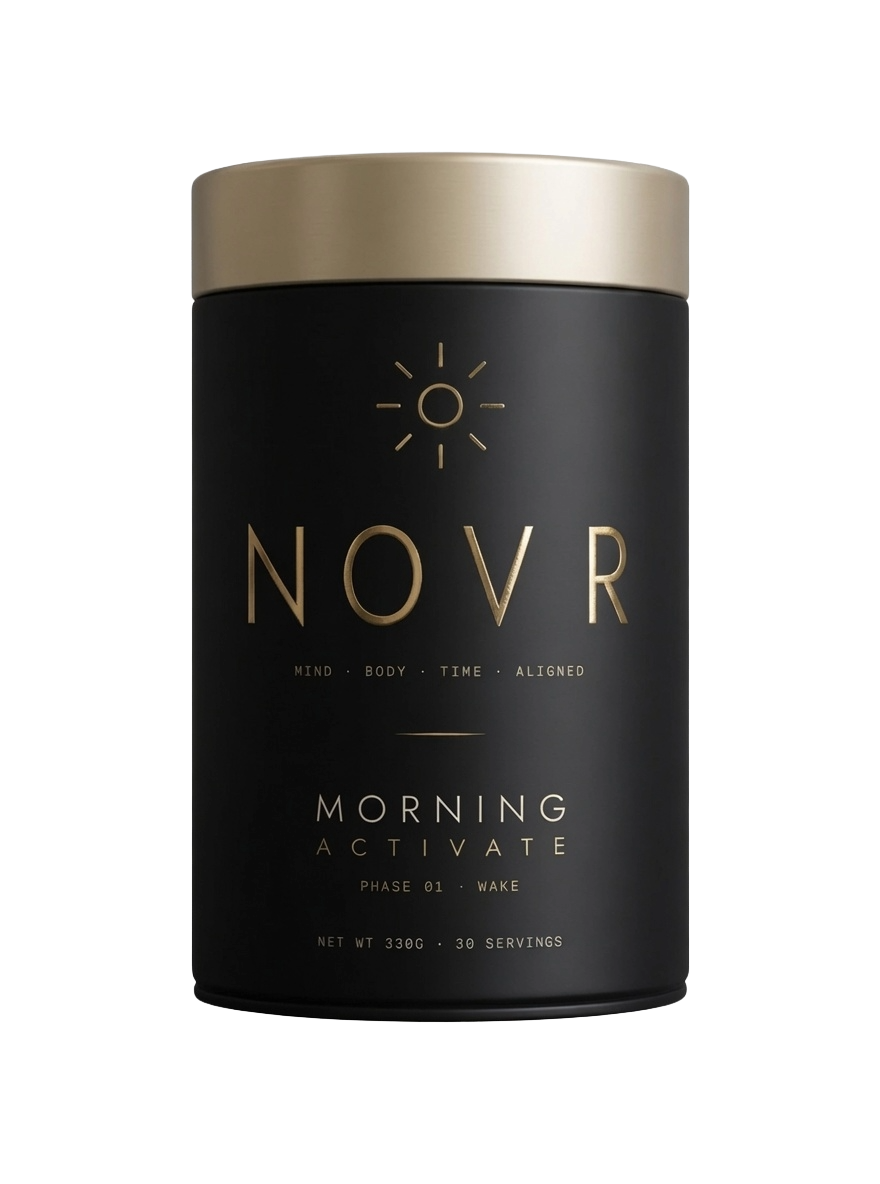
Stirred into about 500 ml of cold water, alongside your usual coffee. 75 mg caffeine. Not after 2 pm.
Each line is one biological signal plotted across a full 24 hours; the dotted marker is the hour you're viewing. You're looking at cortisol — it rockets up after wake, peaks mid-morning, then drains to almost nothing by night. That shape is the whole point: a morning body and a night body are in very different states — which is why NOVR is three separate formulas for different times of day.
Biology is a chain reaction — move one link and everything after it shifts. Click any node to see what it sets off, and where NOVR fits.
Switch on a real-world disruptor and eleven downstream markers re-equilibrate live — because cortisol shifts HRV, HRV shifts dopamine, dopamine shifts sleep depth, sleep depth shifts inflammation. An illustrative model for general education: the numbers are not measurements, and nothing here shows the effect of any product.
Layer one or many disruptors. Each is a real-world insult to the diurnal system — the body adjusts instantly.
You've seen the day your body runs, and what knocks it off course. NOVR is three formulas, each dosed and timed to one window of that day. Let's start where the day starts.
See the product →
Built for the start of the day: a measured caffeine dose with L-theanine, botanical extracts, cocoa flavanols and a set of vitamins and minerals. Tap any ingredient for the detail.
A cold peppermint-and-cocoa drink for the first part of the day. Here's the routine — what's in it is below.
Stir one serving of powder into roughly 500 ml of cold water. Peppermint and cocoa flavour.
Morning contains 75 mg caffeine per serving. It's designed to sit alongside your normal coffee, not replace it — just count it in your daily caffeine total.
Caffeine stays in the body for hours, so Morning is a morning-only drink. Don't take it after 2 pm.
No proprietary blends. Each ingredient is dosed to the levels used in published studies of that ingredient, and every amount is printed on the pack.
A morning drink, timed to the start of your day — every dose on the label.
The familiar one, at a measured dose.
Caffeine blocks adenosine receptors — adenosine is the signal of building sleep pressure. Its effects last for hours, which is why Morning has a 2 pm cut-off.
75 mg per serving, stated on the label, so you can count it alongside your usual coffee.
An amino acid found naturally in tea.
An amino acid found naturally in tea leaves. It has been studied in published human trials, including alongside caffeine (for example Kelly et al., J Nutr, 2008).
200 mg per serving, a dose used in published studies of L-theanine.
A form of choline, also made by the body itself.
Citicoline (CDP-choline) is a compound the body makes from choline. It has been the subject of published human studies.
250 mg per serving, a dose used in published studies.
A branded, standardised sage extract.
Sage has a long culinary and traditional history. Cognivia™ is a standardised sage extract that has been used in published human studies.
600 mg per serving, the dose used in published studies of this extract.
A standardised extract of Panax ginseng root.
G115® is a standardised Panax ginseng extract that has been used in published human studies at 200 mg.
200 mg per serving.
Plant compounds found naturally in cocoa beans.
Most cocoa flavanols are lost in ordinary chocolate processing. Large studies such as COSMOS have used around 500 mg of cocoa flavanols a day.
About 500 mg per serving — and part of the peppermint-and-cocoa flavour.
Vitamin B6, vitamin B12, vitamin C and pantothenic acid contribute to the reduction of tiredness and fatigue.
Pantothenic acid contributes to normal mental performance. Vitamins B6, B12, C and folate contribute to normal psychological function.
Vitamin B6 1.4 mg, vitamin B12 2.5 µg, vitamin C 80 mg and pantothenic acid 6 mg — each 100% of the daily Nutrient Reference Value (NRV).
Zinc and iodine contribute to normal cognitive function.
Folate contributes to normal psychological function, alongside vitamins B6, B12 and C.
Zinc 10 mg, iodine 150 µg and folate 200 µg — each 100% of the daily NRV.
Vitamin D contributes to the normal function of the immune system.
In the UK, sunlight is too weak for the skin to make vitamin D for much of the year, which is why UK government advice is that everyone should consider a vitamin D supplement in autumn and winter.
25 µg per serving (500% of the NRV).
Caffeine and L-theanine are a long-studied pairing; citicoline, sage and ginseng are each included at doses used in published research; cocoa flavanols come with the flavour; and the vitamins and minerals carry the authorised claims shown above. No proprietary blends.
Contains caffeine: 75 mg per serving. Full label on the product page.
See the product →
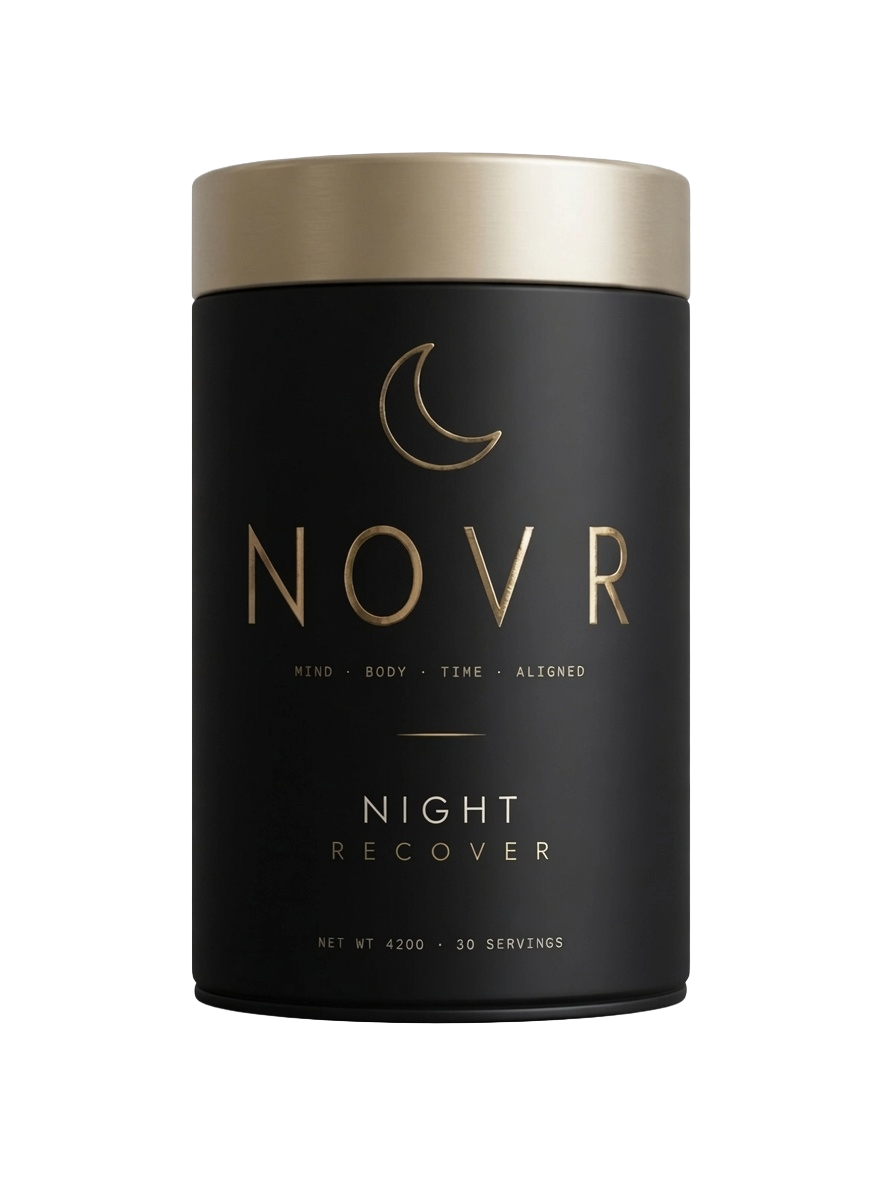
A warm drink for the end of the day: about 150–200 ml of warm (not boiling) water, 60–90 minutes before bed. Chamomile and vanilla flavour.
A warm chamomile-and-vanilla drink for your evening routine. Here's how it fits — what's in it is below.
Make Night as part of your evening wind-down, an hour or so before you plan to sleep.
Stir one serving into warm water. Chamomile and vanilla flavour, with no caffeine-containing ingredients.
Food supplements aren't a substitute for a varied diet and a healthy lifestyle. A regular bedtime, dim evening light and no late caffeine still matter most.
Glycine, L-serine, magnesium, L-theanine, saffron, lemon balm, potassium, oat beta-glucan, taurine, thiamine, vitamin B6, zinc and chromium — each dose stated, no proprietary blends. Contains oats (gluten).
A warm evening drink — every dose on the label.
The simplest amino acid, found in protein foods such as meat, fish and bone broth.
Glycine 3 g taken before bed was studied in a small human trial by Yamadera et al. (Sleep and Biological Rhythms, 2007).
3 g per serving — the amount used in that study.
An amino acid the body also makes itself, and from which it makes glycine.
L-serine is present in many protein foods. Human research on it is at an earlier stage than for glycine.
1.75 g per serving.
Magnesium contributes to normal psychological function, the normal functioning of the nervous system and the reduction of tiredness and fatigue.
Bisglycinate is magnesium bound to glycine. 250 mg is the amount of elemental magnesium per serving.
250 mg elemental magnesium (67% of the NRV).
An amino acid found naturally in tea.
L-theanine has been studied in published human trials, often at around 200 mg.
200 mg per serving.
A standardised extract of the saffron spice.
affron® is a branded saffron extract that has been used in published human trials at 28 mg a day.
28 mg per serving.
A standardised extract of lemon balm (Melissa officinalis).
Lemon balm has a long history as a herbal tea. Relissa™ is a standardised extract of it that has been used in published human studies.
400 mg per serving.
Potassium contributes to the maintenance of normal blood pressure.
Potassium citrate is a common, well-absorbed form. Consult your doctor first if you have kidney disease or take blood-pressure medication.
300 mg potassium (15% of the NRV).
Beta-glucans from oats contribute to the maintenance of normal blood cholesterol levels.
The beneficial effect is obtained with a daily intake of 3 g of oat beta-glucan; one serving of Night provides 1 g. Contains oats (gluten).
1 g per serving.
An amino acid found naturally in meat and fish.
Taurine is also made by the body.
1 g per serving.
Thiamine contributes to the normal function of the heart. Vitamin B6 contributes to normal psychological function and to the regulation of hormonal activity.
Zinc contributes to the protection of cells from oxidative stress. Chromium contributes to the maintenance of normal blood glucose levels.
Thiamine (vitamin B1) 1.1 mg (100% NRV), vitamin B6 1.4 mg (100% NRV), zinc 1.5 mg (15% NRV) and chromium 40 µg (100% NRV).
Contains oats (gluten). Not suitable during pregnancy or breastfeeding, or for under-18s. If you take antidepressants or other prescription medicines, consult your doctor before use. Consult your doctor if you have kidney disease or take blood-pressure medication. Do not combine with alcohol or sleeping medicines. Full label on the product page.
Each formula is made for one part of the day: Morning for the start of the day, Social for the occasional event, and Night for the hour or so before bed. Three times of day, three different formulas.
Different times of day, different formulas. A day has three parts. So NOVR has three formulas.
Five questions. Your chronotype is where your internal clock sits in the population — and it can help you decide when, within each window, to take NOVR. Indicative profile, not a clinical MEQ.
Five questions. Sixty seconds. An indicative rhythm profile — not a medical assessment. Shows how aligned your day currently is, and which daily habit to look at first.
Not all science is equal. This is how we think about the strength of research — general education, not a claim about any product. Most-trusted at the top.
Multiple randomised controlled trials in humans, with peer-reviewed outcomes. Replicated across labs.
Clear biological mechanism understood from in-vivo studies, with supportive (if smaller) human trials.
Mechanism is mapped in lab models, with early-stage human signals. Promising direction; not yet at meta-analysis weight.
Currently preclinical or theoretical. Interesting, but a hypothesis, not a promise.
The body-clock science this page draws on, plus examples of published studies on some of NOVR's ingredients. Listing a study describes the research only — it is not a claim that NOVR has the same effect.
Founders edition. £119/month for life. £50 to reserve.
Body
What's in Social — and why.
Three capsules, about 30–45 minutes before going out and at least 4 hours before bed. For occasional use, not a daily supplement.
How to take Social.
Social is three capsules per serving, for occasional use. Its vitamins B6 and B12 carry authorised health claims; the botanicals and caffeine do not, so for those we only state the doses and when to take it.
Take three capsules with water around 30–45 minutes before going out, and at least 4 hours before bed. One serving (three capsules) a day at most.
Social is made for particular evenings and occasions. It isn't a daily supplement.
L-theanine 200 mg, caffeine (natural) 50 mg, lemon balm extract 300 mg, saffron extract 30 mg, Panax ginseng extract (G115) 200 mg, common sage leaf 600 mg, vitamin B6 1.4 mg and vitamin B12 2.5 µg. Nothing hidden in a blend.
Contains caffeine (50 mg). Not suitable during pregnancy or breastfeeding, or for under-18s. If you take antidepressants or other prescription medicines, consult your doctor before use. Does not reduce the effects of alcohol. Do not exceed one serving a day.
Contains caffeine: 50 mg per serving. Every dose on the label.
An amino acid found naturally in tea.
L-theanine has been studied in published human trials, often at around 200 mg.
200 mg per serving (three capsules).
An extract of Melissa officinalis, a herb in the mint family.
Lemon balm has a long history as a herbal tea and has been studied as a standardised extract in published human trials.
300 mg per serving.
A standardised extract of the saffron spice (Crocus sativus).
Standardised saffron extracts have been used in published human trials at around 28–30 mg a day.
30 mg per serving.
Natural caffeine. 50 mg per serving.
Caffeine's effects last for hours, which is why Social is taken at least 4 hours before bed.
50 mg per serving, stated on the label, so you can count it alongside any coffee or tea that day.
A standardised extract of Panax ginseng root.
The dose used in its published human studies.
200 mg per serving.
Leaf of common sage (Salvia officinalis).
The dose used in its published human studies.
600 mg per serving.
Vitamins B6 and B12 contribute to normal psychological function and to the reduction of tiredness and fatigue.
Both are essential vitamins found in a varied diet.
Vitamin B6 1.4 mg and vitamin B12 2.5 µg — each 100% of the daily Nutrient Reference Value (NRV).
Social combines L-theanine, natural caffeine, lemon balm, saffron, Panax ginseng and sage with vitamins B6 and B12, each at a dose used in published studies of that ingredient. Contains caffeine: 50 mg per serving. No proprietary blend.
Three capsules, around 30–45 minutes before going out and at least 4 hours before bed. Not for daily use. Full label on the product page.